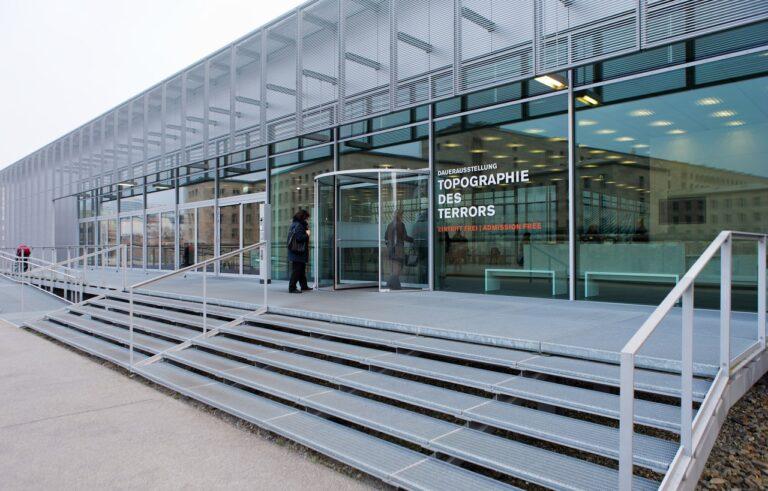
Stasi Museum
The Stasi, which is short for “Ministerium für Staatssicherheit” and means Ministry of State Security, was the secret police of the German Democratic Republic, or East Germany. It was the organ of the communist government to repress and oppress its citizens in order to maintain the regime. But the Stasi also operated abroad, it had agents who did espionage and covert operations.
The Stasi spied on and monitored people all the time, mainly through a vast network of “Inoffizieller Mitarbeiter” (meaning “unofficial officials”). As the name suggests, the Inoffizieller Mitarbeiter were people who were not formally employed by the Stasi, but who worked for it.
These “unofficial employees” were supposed to monitor people in their personal, professional and often even family spheres and report their behavior and actions to the Stasi. The activities observed and the information about the spied upon were recorded in detail and filed.
The citizens had to think about their actions, their words. They had to think about what they were going to say, to whom they were going to say it, because they never knew whether the person they were dealing with was an informer or not.
The aim was to combat any political opposition, often using the most absurd means, such as the technique known as Zersetzung, which literally means decomposition, and which consisted of psychologically persecuting people considered by the state to be opponents or enemies.
Video
Using information obtained through espionage, the Stasi would develop a social-psychological profile of the person considered an enemy and thus use his or her weak points (e.g., alcoholism, betrayal, interest in pornography, addictions) to attack him or her, usually by spreading rumors to denounce the victim.
Other practices include car sabotage, property damage, food poisoning, deliberately improper medical treatment, tattling, wiretapping, mysterious phone calls. Through anonymous letters and phone calls, incriminating photos (often falsified), friendships, dating, marriages, and relationships between parents and children were to be disrupted. And usually the victims did not know that the Stasi was responsible for all this.
The idea of this method was to exhaust and psychologically destabilize these people so that they no longer had the strength to rebel or act against the regime. It often did not matter that all this psychological terror led a person to total despair and suicide.
The advantage of this method for the communist government was that the damage caused is not obvious or difficult to prove, unlike physical torture, for example. And it was important for East Germany, which was trying to improve its international image in the 1970s and 1980s.
The Stasi was very busy – in 1989 it had 91,015 employees. That was one official for every 180 inhabitants, making it the largest secret service in history. This does not include the Inoffiziellen Mitarbeitern, who numbered 173,081 in 1989.
The Stasi had its headquarters in East Berlin, in the Lichtenberg district, in a gigantic complex consisting of more than 20 buildings. After the fall of the Wall and the beginning of the collapse of the East German regime, protesters stormed the Stasi headquarters on January 15, 1990.
In December 1991, a law came into effect that the Stasi archives were to be opened, so that those affected, those who had been spied upon, could have access to their files, to the information that the Stasi had collected and stored about them.
Today, the Stasi Museum is located in Building No. 1, where the office of the Stasi minister, Erich Mielke, was located. And Erich Mielke’s office is probably what attracts people’s curiosity the most, because it has been kept and preserved as it is and is part of the museum’s exhibition.
The means used to spy on people are also very interesting: various cameras hidden in the most diverse objects are displayed in the museum. In addition, the exhibition deals with different aspects of the political system, as well as the opposition and resistance to the regime.
The Stasi Museum is open Monday to Friday from 10:00 am to 6:00 pm; Saturdays, Sundays and holidays from 12:00 pm to 6:00 pm. Please confirm opening hours on the museum website as they are subject to change.
How to get there
U-Bahn: Line U5, station Magdalenenstr.
Price: 8 € for adults, 3 € for children over 12 years old.
Opening hours: Monday to Friday: 10 am – 6 pm, Saturday, Sunday: 11 am – 6 pm
https://www.stasimuseum.de/
Address: Ruschestraße 103 – Haus 1 (Building 1) – Lichtenberg – 10365 Berlin
https://goo.gl/maps/iga3aY7vyFkJ46cCA